
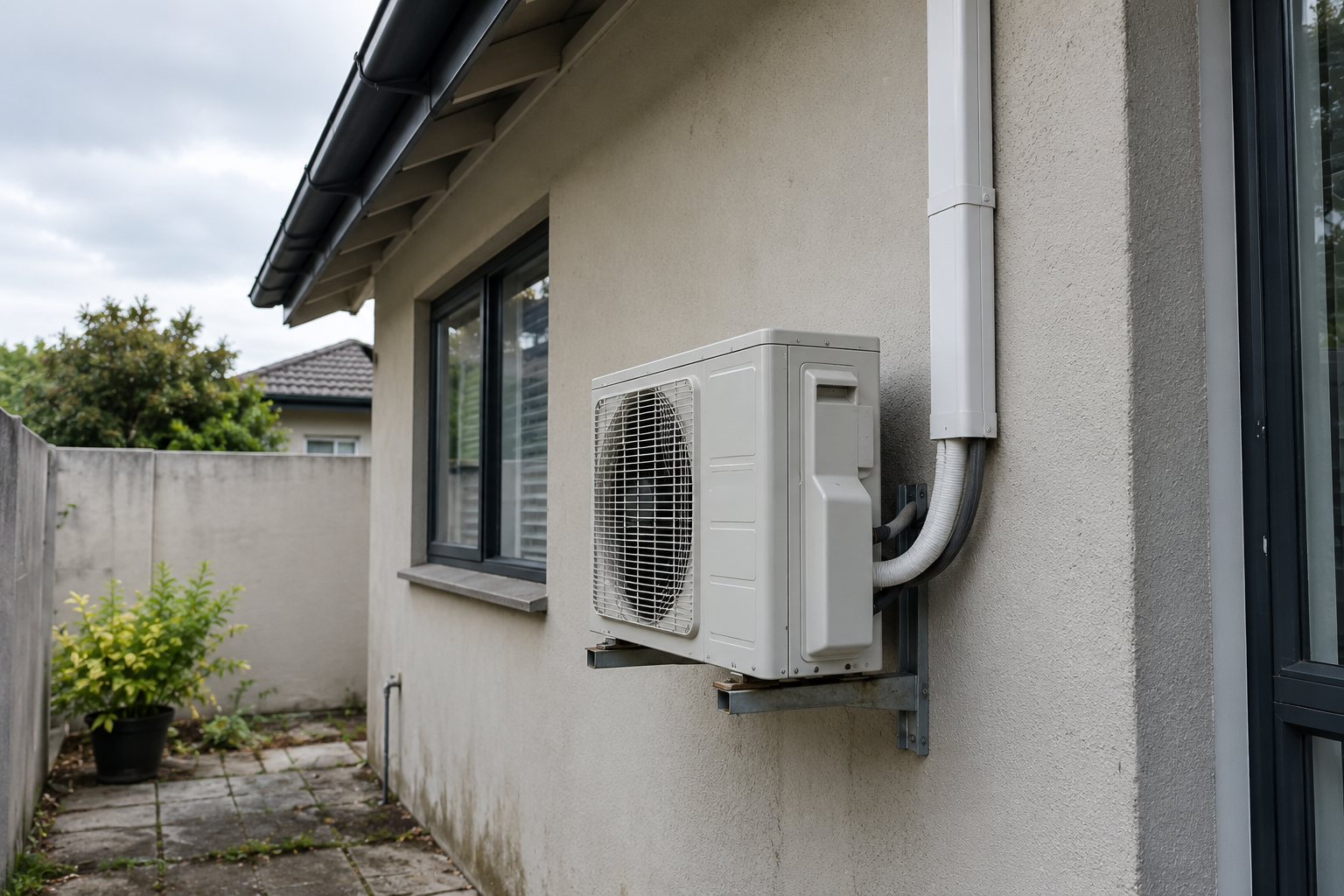
An air conditioner might seem like a fairly simple addition to a property. Choose a unit, put it on the wall, connect it to the outdoor unit and switch it on.
The installation itself is where things become more complicated.
A typical split-unit air conditioner needs suitable positioning, secure mounting, refrigeration pipework, condensation drainage, electrical connections and an outdoor location where the condenser can operate properly and remain accessible for maintenance. The distance between the indoor and outdoor units, the construction of the property and the accessibility of the installation area can all affect the amount of work involved.
So, how much does aircon installation cost in Cape Town?
As a general budgeting guide, a residential split-unit aircon installation can range from approximately R6,500 to R28,000 or more, including the aircon unit and a relatively standard installation, depending on the system capacity and installation requirements. Smaller systems may fall towards the lower end of that range, while larger systems, premium equipment and more complicated installations can cost considerably more.
For example, a rough budgeting guide for common residential systems could look like this:
| Aircon capacity | Approximate installed budget |
|---|---|
| 9,000 BTU | R6,500 to R10,500 |
| 12,000 BTU | R7,500 to R13,000 |
| 18,000 BTU | R11,000 to R18,000 |
| 24,000 BTU | R16,000 to R28,000 |
| Larger systems or complex installations | R25,000+ |
These are estimated budgeting ranges, not fixed King Handyman prices. The actual cost can only be determined properly once the aircon, room and installation conditions have been considered.
King Handyman provides aircon installation in Cape Town for residential and commercial properties, with the installation planned around the particular system and property rather than treating every job as identical.
Request an Installation Quote
Fill in the form below and we will contact you about your aircon installation.
Why Aircon Installation Prices Vary So Much
The biggest mistake when estimating an aircon installation is looking only at the price of the unit.
An air conditioner is part of a larger installation. The indoor unit needs to be positioned correctly, the outdoor unit needs a suitable location, and the two need to be connected through the building in a way that allows the system to operate properly.
A straightforward installation might involve an indoor unit mounted on an exterior wall with the outdoor condenser positioned immediately on the other side. The pipework can be kept relatively short, access is easy and there are few obstacles.
Now compare that with an apartment where the indoor unit is several metres from the nearest suitable outdoor position. The pipework has to travel along the wall, drainage needs to be planned carefully, access is restricted and the outdoor unit needs additional consideration.
Both properties may be installing the exact same 12,000 BTU aircon.
The installation costs can still be very different.
That is why an accurate quotation should consider the complete installation rather than applying one standard price to every property.
The Aircon’s Capacity Affects the Overall Cost
The capacity of the air conditioner is one of the first factors affecting the budget.
Aircon capacity is commonly expressed in BTU, or British Thermal Units. In simple terms, the capacity gives an indication of how much heating or cooling the system can provide.
A small bedroom may only need a relatively small unit. A large lounge, open-plan living area or commercial space may require considerably more capacity.
The temptation is to assume that a larger aircon is automatically better because it has more cooling power.
That is not necessarily the case.
The system needs to be suitable for the room. An undersized unit may struggle to maintain a comfortable temperature, particularly during demanding conditions. An oversized unit may also be an inappropriate choice if the space does not require that level of capacity.
Room size is important, but it is not the only factor. Windows, direct sunlight, insulation, ceiling height, occupancy and the way the room is used can all influence the requirements.
For this reason, choosing an aircon based solely on the square metres of a room can result in an unsuitable system.
Estimated Cost of a 9,000 BTU Aircon Installation
A 9,000 BTU system is generally suited to smaller rooms such as bedrooms, studies and compact home offices, depending on the conditions of the space.
For budgeting purposes, approximately R6,500 to R10,500 installed is a reasonable starting range for this size of system.
A straightforward installation could sit towards the lower end of the range.
For example, if the indoor unit can be installed on an exterior wall and the outdoor unit can be positioned directly outside with a short connection between them, there may be relatively little additional installation work.
The price can increase where the pipework has to travel further, the outdoor unit is difficult to access or additional electrical or mounting work is required.
The unit itself also influences the final price. Different brands, models, features and efficiency levels can have significantly different purchase prices.
Estimated Cost of a 12,000 BTU Aircon Installation
A 12,000 BTU system is commonly considered for bedrooms, studies, smaller living areas and other spaces where a 9,000 BTU unit may not provide enough capacity.
A reasonable budgeting range is approximately R7,500 to R13,000 installed.
Again, this is an estimate rather than a fixed price.
A 12,000 BTU unit installed in a ground-floor bedroom with an uncomplicated pipe route may be relatively straightforward. The same capacity system in a second-storey room with restricted exterior access can involve considerably more work.
The installation method, distance between the units and condition of the property all matter.
Estimated Cost of an 18,000 BTU Aircon Installation
An 18,000 BTU system is generally used for larger rooms and some open-plan areas.
A reasonable estimated installed budget is approximately R11,000 to R18,000.
At this level, the size and layout of the space become particularly important.
An open-plan living area may have a large amount of glazing, several entrances and areas separated by furniture or changes in the room layout. The installer needs to think about where the indoor unit will distribute air rather than simply finding an empty wall.
The outdoor unit will also be larger than that used for a smaller system, so its support, ventilation and access need to be considered.
Estimated Cost of a 24,000 BTU Aircon Installation
A 24,000 BTU system is more appropriate for larger living spaces and some commercial applications where the cooling requirement is substantially higher.
A reasonable budgeting range is approximately R16,000 to R28,000 installed.
Larger systems can involve more expensive equipment, while the installation may also require additional consideration because of the size and position of the outdoor unit.
If the system is being installed in a large open-plan space, the location of the indoor unit becomes particularly important.
A powerful aircon placed in an unsuitable position will not necessarily cool the entire space evenly. Airflow can be affected by walls, furniture, high ceilings and the shape of the room.
The objective should be to select an appropriate system and position it properly rather than simply buying the largest available unit.
What Does the Installation Part of the Cost Actually Cover?
When someone sees an advertised aircon installation price, it is worth asking exactly what that price includes.
The installation may involve mounting the indoor unit, mounting or positioning the outdoor unit, connecting the units, installing refrigeration pipework, arranging condensation drainage and connecting the system as required.
However, standard installation packages can have limitations.
A basic installation might assume that the indoor and outdoor units are close together and that the property provides straightforward access. A longer pipe route, difficult mounting location, additional drilling or electrical work may fall outside that basic arrangement.
This is one of the reasons two companies can quote noticeably different amounts for what appears to be the same aircon installation.
The important question is not simply:
“How much is installation?”
It is:
“What work is included in the installation price?”
The Distance Between the Indoor and Outdoor Units Matters
The simplest installation is often one where the indoor and outdoor units can be positioned close together.
The further apart they are, the more complicated the connection can become.
Additional pipework may be required, and the route may involve surface trunking or other methods of keeping the installation neat and protected.
A longer route can also involve more drilling and preparation.
This does not mean the indoor and outdoor units should always be placed as close together as possible. The best positions need to take airflow, access, drainage, aesthetics and future servicing into account.
A slightly longer route can sometimes produce a better overall installation if it allows the equipment to be positioned appropriately.
Concealed Pipework Can Increase Installation Costs
Visible pipework is sometimes perfectly acceptable, particularly when it can be routed neatly.
There are situations, however, where the property owner wants the installation to be less noticeable.
Concealing services can require additional work depending on the construction and finish of the property.
This is particularly relevant in renovated interiors where the walls and finishes have already been carefully completed.
The same applies to commercial premises where the appearance of exposed services may not suit the environment.
If the installation requires a more involved route to keep the pipework concealed, that should be accounted for when estimating the cost.
Outdoor Unit Positioning Is More Important Than It Looks
The outdoor condenser needs a suitable location.
It requires adequate airflow around the equipment and should be positioned where it can be accessed for future maintenance.
An outdoor unit squeezed into an unsuitable corner may technically fit, but that does not mean it is a good installation location.
There should also be consideration for how the unit will be supported.
For a ground-level installation, the arrangement may be relatively simple. Wall-mounted outdoor units require suitable support and secure installation. Elevated or difficult-to-access locations require additional planning.
The position should also be considered from a maintenance perspective.
An aircon is not installed once and then forgotten. Filters need attention, the system needs servicing and components may eventually require repair.
Making future access unnecessarily difficult can turn routine maintenance into a much bigger job.
Electrical Work Can Affect the Price
The aircon itself needs an appropriate electrical supply.
Some properties may already have a suitable arrangement. Others may require electrical work before the aircon can be installed.
Where a new circuit or other regulated electrical work is required, this needs to be completed by an appropriately qualified electrical professional.
This is another reason it is risky to assume that an installation has one fixed price regardless of the property.
If electrical work is required, it should be identified as part of the overall planning rather than discovered after the installation has already started.
Condensation Drainage Needs to Be Planned
Air conditioners remove moisture from the air during cooling, producing condensation.
That water needs to be drained away appropriately.
It sounds like a small detail, but poor drainage can create an annoying and potentially damaging problem.
If condensation is not discharged correctly, water can drip from the indoor unit, stain walls or ceilings, damage finishes or create persistent damp areas.
The drainage route therefore needs to be considered alongside the indoor unit position.
A convenient place to mount the aircon is not necessarily the best place if there is no sensible way to manage the condensation.
Does Aircon Installation Cost More in Cape Town Apartments?
It can.
Apartments can introduce access and positioning issues that are less common in some freestanding homes.
The outdoor unit may not be able to go directly outside the room. There may be restrictions on external walls, balconies or visible equipment. Access to the exterior can also be limited.
Sectional-title properties may have rules governing alterations to external areas, so those requirements should be checked before installation.
A City Bowl apartment, for example, may have completely different installation considerations from a ground-floor home in the Southern Suburbs.
The aircon capacity might be identical.
The installation certainly does not have to be.
Aircon Installation in Older Cape Town Properties
Older buildings can present their own challenges.
Walls may be constructed differently from modern properties, existing electrical infrastructure may need assessment and previous alterations may not be immediately obvious.
An older home may also already have an aircon installation that has been modified over the years.
If an existing unit is being replaced, it is tempting to assume that the old brackets, pipework and electrical connections can simply be reused.
That is not always appropriate.
The replacement system needs to be assessed independently. Components that are damaged, unsuitable or incompatible may need to be changed.
This is one reason replacement installations should not automatically be priced in the same way as a simple unit swap.
Should You Repair an Existing Aircon Instead?
Sometimes replacement is not necessary.
An aircon that is not cooling properly may have a maintenance issue, restricted airflow or a repairable fault.
For example, a system that has gradually become less effective may not have suddenly become incapable of cooling the room. Filters, coils, airflow and other components may need attention.
King Handyman provides aircon repairs and servicing in Cape Town as well as installation, so the appropriate solution can depend on the condition of the existing system.
Replacement becomes more relevant when the existing equipment is beyond practical repair, no longer suitable for the space or repeatedly developing problems.
The right decision is not always the one involving the newest aircon.
It is the one that makes sense for the condition of the equipment and the requirements of the property.
Replacing an Aircon Can Still Involve Additional Work
A replacement installation can be simpler than a completely new installation, but it should not automatically be assumed to be a basic job.
The new aircon may have different dimensions, mounting requirements or connection requirements from the old unit.
The existing pipework may not be suitable.
The old outdoor unit may have been installed in a position that is no longer ideal.
The drainage arrangement may also need to be modified.
If the old system has been in place for years, there may be an opportunity to correct poor positioning or tidy an installation that was previously done without much thought for future maintenance.
That can make the replacement a useful opportunity to improve the overall arrangement.
What About Relocating an Existing Aircon?
Relocation can make sense when the aircon is still suitable but its current position no longer works.
This might happen after a renovation, room conversion or change in the layout of the property.
Moving an aircon involves more than removing it from one wall and attaching it somewhere else. The new location needs to accommodate the indoor unit, outdoor unit, refrigeration connections and drainage.
The existing system also needs to be considered.
If an older unit is already becoming unreliable, spending money relocating it may not be the most sensible long-term decision.
On the other hand, a relatively suitable system that simply occupies a poor position may benefit from relocation.
Aircon Installation for Offices and Commercial Properties
Commercial aircon installation can be considerably different from residential work.
An office, shop or other commercial property may have larger spaces, more occupants, computers, lighting and equipment generating heat.
Operating hours can also be much longer than those of a typical home.
The property layout becomes particularly important. A system that works well in one enclosed office may not be suitable for a large open-plan workspace.
King Handyman provides commercial air-conditioning services in Cape Town, including installation, replacement, repair, servicing and maintenance. The requirements of the property and its use need to be considered when determining the appropriate solution.
Commercial installation costs can therefore extend well beyond the residential ranges discussed earlier.
A larger system, multiple indoor units, more extensive pipework or difficult access can all increase the scope.
How Much Should You Budget for a Complete Aircon Installation?
If you are planning a new residential installation, it helps to start with a realistic budget rather than expecting every job to cost the same.
For a smaller bedroom system, a budget of around R6,500 to R10,500 may be reasonable.
For a 12,000 BTU system, approximately R7,500 to R13,000 provides a useful starting point.
For an 18,000 BTU system, approximately R11,000 to R18,000 may be appropriate for initial budgeting.
For a 24,000 BTU system, a budget of approximately R16,000 to R28,000 is more realistic.
These figures are broad estimates and can move outside those ranges.
A premium aircon can increase the equipment cost. A complicated installation can increase labour and materials. Additional electrical work, longer pipework, difficult access, unusual mounting requirements or removal of existing equipment can also affect the final quotation.
The figures should therefore be used to establish a budget, not to assume that a particular installation will cost exactly that amount.
Request an Installation Quote
Fill in the form below and we will contact you about your aircon installation.
What Information Does King Handyman Need for a Quote?
The more information available about the proposed installation, the easier it is to understand what the work may involve.
If you already own the aircon, have the make, model and capacity available.
Photographs of the proposed indoor and outdoor installation areas are also useful. A photo showing the entire wall can provide more context than a close-up of the spot where the unit might go.
Room dimensions can help with assessing the required capacity, while information about the property’s layout can help identify potential installation challenges.
It is also useful to mention whether the property is:
- A freestanding house
- An apartment or sectional-title property
- An office
- A commercial property
Other useful information includes whether an existing aircon needs to be removed, whether the new unit is replacing an old one and whether there are known access restrictions.
A proper assessment can then determine what the installation actually requires rather than relying on assumptions.
What Should You Look for When Comparing Aircon Installation Quotes?
Do not compare quotations based only on the final number.
Look at what each quotation includes.
One quote may include the aircon and standard installation. Another may cover installation only. One may include a particular length of pipework while another assumes a shorter route.
This is particularly important where the outdoor unit is not going directly behind the indoor unit.
Check whether the quotation accounts for the mounting arrangement, pipework, drainage, electrical requirements and any removal or relocation work.
The cheapest quotation can look attractive until additional requirements are added later.
A more useful quotation is one that clearly reflects the actual installation.
Is the Cheapest Aircon Installation the Best Choice?
Not necessarily.
There is nothing wrong with choosing an economical installation when the property allows for a straightforward solution.
The problem comes when price becomes the only consideration.
An installation needs to be practical, secure and suitable for the system. The indoor unit needs appropriate airflow, the outdoor unit needs adequate ventilation and access, and the connections between the two need to be properly planned.
Saving a relatively small amount by choosing an unsuitable installation arrangement can create considerably more inconvenience later.
It is better to understand why one quotation is cheaper than another.
If one property genuinely requires less work, the lower price may be completely justified.
If important work has simply been left out of the quotation, the apparent saving may not last.
Common Aircon Installation Mistakes
A few mistakes repeatedly cause problems because they focus on the visible aircon unit rather than the complete system.
One is choosing the unit solely according to price. A cheap aircon that is not appropriate for the room can perform poorly and may not provide the comfort expected.
Another is choosing the installation position without considering airflow. The most convenient wall is not automatically the best wall.
There is also the temptation to hide every part of the installation at all costs. Concealing pipework can improve the appearance of a property, but an unnecessarily complicated route can increase installation work and make future maintenance more difficult.
Another mistake is ignoring the outdoor unit until installation day. The condenser needs appropriate space, support, airflow and access.
Finally, an existing installation should not be reused automatically during replacement. Every component should be considered according to the new system.
How Cape Town’s Environment Can Affect Aircon Installation
Cape Town’s different residential and commercial environments can create different considerations for outdoor equipment.
Properties close to the coast may experience exposure to salt-laden air. Dust, wind and debris can also affect outdoor components.
This makes the position of the outdoor unit particularly important.
The unit should have sufficient airflow and should be accessible enough to allow proper servicing. Placing it somewhere simply because it is out of sight can make future maintenance unnecessarily difficult.
The environment also reinforces the importance of looking after the system after installation.
A properly installed aircon still needs appropriate maintenance if it is going to continue operating effectively.
How to Keep Aircon Installation Costs Under Control
Keeping the cost under control does not necessarily mean finding the cheapest installer.
Good planning can prevent unnecessary work.
Start by choosing an aircon that is appropriate for the room rather than simply choosing the cheapest or most powerful unit.
Think about the indoor and outdoor positions before purchasing the system. If the proposed locations are practical and reasonably close together, the installation may be simpler.
Provide useful information when requesting a quotation. Photos, room dimensions, the aircon model and details about the property can help establish the scope more accurately.
If you are replacing an existing system, establish whether repair, servicing or replacement is actually appropriate before spending money on a completely new installation.
And if the property is an apartment or commercial premises, identify access or building requirements early.
Good planning does not eliminate every additional cost, but it reduces the likelihood of discovering major installation complications halfway through the job.
Why a Site Assessment Can Be Worthwhile
A site assessment allows the installation to be considered as a complete system.
The installer can look at the proposed indoor position, outdoor position, pipework route, drainage, access and other practical factors.
This is particularly useful where the installation is not straightforward.
A photograph can show where an aircon might fit, but it cannot always reveal everything that will affect the work. The wall construction, access, route behind or around the property and location of existing services may only become clear when the installation is properly assessed.
For more complicated Cape Town properties, this can be the difference between a realistic quotation and an estimate that changes once work begins.
Choosing the Right Aircon Is Only Half the Job
A good air conditioner still needs a good installation.
The equipment can have the right capacity and excellent features, but poor positioning or an unsuitable installation arrangement can undermine the result.
The indoor unit needs to distribute air effectively. The outdoor unit needs appropriate airflow. Condensation needs to drain properly. Connections need to be installed correctly. Electrical requirements need to be dealt with appropriately, and the system should remain accessible for future maintenance.
That is why the installation should be considered at the same time as the aircon purchase.
The cheapest unit combined with a poorly planned installation is not necessarily the cheapest solution in the long run.
Conclusion
Aircon installation costs in Cape Town vary because no two properties necessarily present the same installation conditions.
As a general budgeting guide, a smaller 9,000 BTU residential system may cost around R6,500 to R10,500 installed, while a 12,000 BTU system may fall around R7,500 to R13,000. An 18,000 BTU installation can be budgeted at approximately R11,000 to R18,000, while a 24,000 BTU system can be around R16,000 to R28,000. Larger systems and more complicated installations can exceed these ranges.
The final cost depends on much more than BTU capacity. The aircon model, room layout, indoor and outdoor positions, pipework, drainage, electrical requirements, accessibility, mounting arrangements and condition of existing equipment can all affect the project.
A sensible budget is therefore a starting point, not a promise of what every installation will cost.
If you are installing an aircon in a Cape Town home, apartment, office or commercial property, the most useful approach is to assess the actual installation conditions first. That gives you a clearer understanding of what needs to be done, what materials and work may be involved and which solution makes sense for the property.
Request an Installation Quote
Fill in the form below and we will contact you about your aircon installation.