
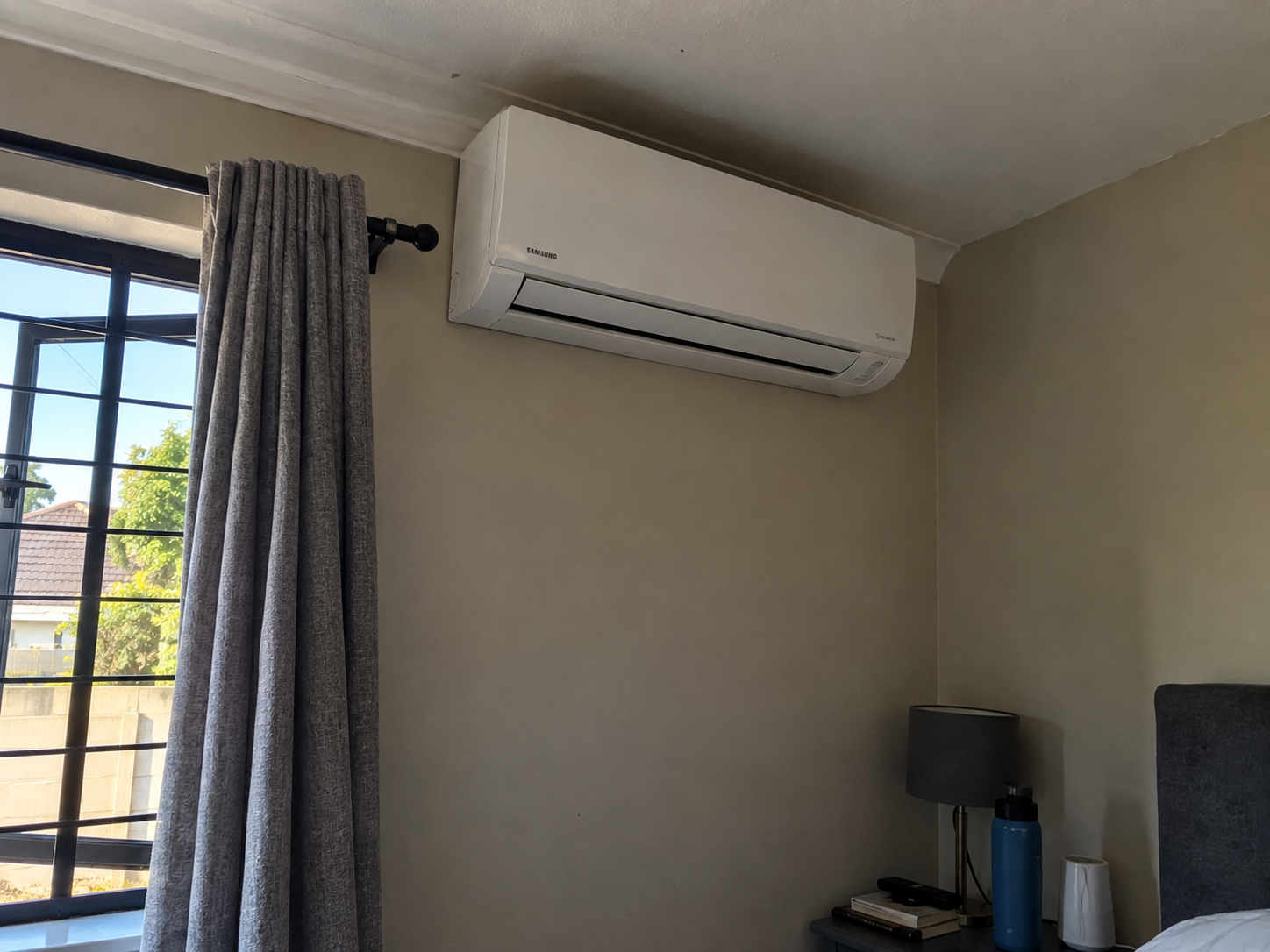
An air conditioner can be one of those appliances you barely notice until the electricity bill arrives. A unit that runs for several hours a day can use a meaningful amount of electricity, but the actual figure depends on far more than the size printed on the aircon.
A 12,000 BTU unit does not necessarily consume the same amount of electricity every hour. How hard the compressor has to work, the temperature you set, the size and condition of the room, sunlight through windows, insulation and even how clean the system is can all affect consumption.
There is also an important distinction between the capacity of an air conditioner and the electricity it consumes. BTU tells you about cooling capacity. Electricity consumption is measured in watts or kilowatts, while your electricity bill is based on kilowatt-hours.
Understanding that difference makes it much easier to estimate what your aircon is actually costing to run.
Get the Aircon Advice Your Property Needs
Not sure whether your current aircon is using more electricity than it should? King Handyman can assess the system, identify possible causes and advise on appropriate servicing or repairs.
What Does an Aircon Actually Use on the Electricity Bill?
Air conditioners are electrical appliances, so their consumption is ultimately measured in kilowatt-hours (kWh).
The calculation is straightforward:
Electricity used = power consumption × running time
For example, if an air conditioner were drawing 1.2 kW continuously and operated for five hours, the theoretical consumption would be:
1.2 kW × 5 hours = 6 kWh
If the electricity rate were R3.00 per kWh, that would work out to:
6 kWh × R3.00 = R18.00
That is only an illustration. Actual electricity tariffs vary according to the property, municipality and tariff structure, so the most useful figure for calculating your own running cost is the electricity rate shown on your bill.
More importantly, the aircon may not draw 1.2 kW for all five hours.
This is where things become interesting.
Once a room has reached the desired temperature, an inverter air conditioner can reduce compressor output rather than continually operating at its maximum level. Consequently, an aircon that is switched on for five hours does not automatically use its maximum rated power for all five hours.
A non-inverter system behaves differently because its compressor generally operates at a fixed speed, switching on and off as cooling is required.
So the number of hours an aircon is switched on gives you a starting point, but it does not tell the whole story.
BTU Size and Electricity Consumption Are Related, But They Are Not the Same Thing
Aircon capacity is commonly described in BTU, such as:
- 9,000 BTU
- 12,000 BTU
- 18,000 BTU
- 24,000 BTU
A larger unit generally has a greater cooling capacity and can require more electrical power when operating. But that does not mean that choosing the smallest possible aircon will automatically save electricity.
An undersized unit can struggle to bring a room down to the desired temperature. If it is constantly working under heavy demand, the expected electricity savings from choosing a smaller unit may not materialise.
Imagine two rooms.
The first is a reasonably insulated bedroom with moderate sunlight and relatively little heat entering the space. The second is a large living area with extensive windows, afternoon sun, several occupants and heat-producing appliances.
Putting the same aircon in both rooms would create very different operating conditions.
The second system may have to work considerably harder, even if both air conditioners are identical.
This is why proper aircon sizing matters. Room size, ceiling height, windows, direct sunlight, insulation, occupancy and heat generated by equipment can all influence the cooling requirement.
A Simple Way to Estimate Your Own Aircon’s Electricity Use
You do not need to guess based solely on BTU.
Look at the aircon’s specifications for its electrical input or rated power consumption. This may be expressed in watts (W) or kilowatts (kW).
If the figure is given in watts, divide it by 1,000.
For example:
1,500 W ÷ 1,000 = 1.5 kW
You can then use:
1.5 kW × hours of operation = estimated kWh
If the unit operated at that power for four hours:
1.5 kW × 4 = 6 kWh
For a 30-day month, running it for four hours every day would give:
6 kWh × 30 = 180 kWh
You can then multiply 180 kWh by the applicable electricity rate to estimate the energy cost.
There is one major limitation: rated input is not necessarily the same as average real-world consumption.
An inverter system, in particular, may consume considerably less than its maximum rated input once the room has reached temperature.
The calculation is therefore useful for understanding the potential consumption of your system, but your actual electricity use can only be established accurately by measuring it or examining your property’s electricity data.
Why Two Identical Aircons Can Use Different Amounts of Electricity
This is one of the most useful things to understand when looking at your electricity bill.
Suppose two households have exactly the same 12,000 BTU air conditioner.
One person uses it in a small bedroom for three hours at night. The room has curtains, moderate insulation and little direct sunlight.
The other uses the same capacity unit in a room with large windows that receive strong afternoon sun. The doors are opened frequently and several people occupy the room.
The air conditioners may have the same specifications, but their workload is completely different.
Heat entering the room
An air conditioner is constantly dealing with heat entering the space.
Sunlight through windows can add substantial heat. Poor insulation can allow heat to move through walls and ceilings more easily. Open doors allow conditioned air to escape while warmer air enters.
The harder the system has to remove that heat, the longer or more intensely it may need to operate.
Room occupancy
People generate heat.
A room occupied by several people can therefore require more cooling than the same room occupied by one person.
The difference becomes more noticeable in offices, shops and other spaces where occupancy is higher for extended periods.
Computers, lighting and appliances
Electrical equipment also produces heat.
A home office containing computers and monitors can place a greater cooling demand on an air conditioner than a bedroom containing very little equipment.
Commercial spaces can have an even greater load because of computers, lighting, kitchen equipment and other heat-producing appliances.
Windows and sunlight
A room with extensive glazing can become significantly warmer during sunny periods.
This is particularly relevant when an aircon is used during the warmer part of the day. The system may need to remove incoming heat continuously rather than simply cooling the room once and maintaining the temperature.
Your Temperature Setting Makes a Difference
Setting an air conditioner to an extremely low temperature does not necessarily make it cool a room faster in the way people sometimes expect.
If a room is uncomfortable, dropping the thermostat dramatically can cause the system to continue working towards a much colder target than is actually necessary.
A more moderate temperature can reduce the cooling demand while still making the room comfortable.
For example, there is a considerable difference between asking an aircon to maintain a comfortable indoor temperature and asking it to maintain a very cold room while the outdoor temperature is high.
The greater the difference between the indoor target and the conditions outside, the more work may be required.
This becomes particularly relevant when an aircon is left running for long periods.
Inverter Aircons Can Change Their Electricity Consumption
The way an air conditioner controls its compressor has a major influence on how it uses electricity.
An inverter system can vary compressor speed according to the cooling demand. Instead of simply operating at full output and then switching off, it can reduce output once the desired indoor conditions have been reached.
That can make inverter technology particularly useful when an aircon is used for extended periods.
For instance, a bedroom aircon running for a short period may have a different consumption pattern from an aircon operating throughout a working day in a home office.
A non-inverter unit can still cool effectively, but its compressor generally operates differently, cycling on and off rather than continuously adjusting its speed.
The choice between the two therefore involves more than the purchase price. Expected operating hours, comfort, room conditions and long-term electricity use all deserve consideration.
An Aircon That Runs Constantly Is Not Necessarily Broken
There is a difference between running continuously and running continuously under excessive load.
An air conditioner may need to operate for a long time when:
- the room is large relative to its capacity
- sunlight is heating the room
- doors or windows are frequently open
- insulation is poor
- the temperature setting is very low
- the outdoor conditions are demanding
- the system is dirty or restricted
An inverter system may also continue running at a reduced output because maintaining a stable temperature can be more efficient than repeatedly allowing the room to warm up and then cooling it again.
The important question is therefore not simply, “Does my aircon run all the time?”
It is, “Is the system maintaining the room properly while operating normally, or is it struggling to achieve the desired conditions?”
If the room remains warm despite prolonged operation, or the unit repeatedly switches off unexpectedly, there may be another problem worth investigating.
Dirty Filters Can Affect Electricity Consumption
Airflow is fundamental to air conditioning.
A dirty filter can restrict the amount of air moving through the indoor unit. Dust and debris can also accumulate on components that need to transfer heat efficiently.
When airflow is restricted, the system may not perform as it should. It can take longer to achieve the desired conditions, and the cooling system may have to work harder.
That is one reason regular servicing is about more than keeping an aircon looking clean.
Aircon servicing and maintenance from King Handyman can include inspection and cleaning of relevant components, checking drainage and assessing cooling performance.
The appropriate servicing interval depends on how the system is used and its environment. An aircon used for several hours every day in a dusty environment will not necessarily have the same maintenance requirements as one used occasionally in a relatively clean bedroom.
Coastal Conditions Can Add Another Consideration
Cape Town’s coastal environment can expose outdoor aircon equipment to salt-laden air, while dust, wind and debris can also affect the outdoor unit.
The outdoor section needs adequate airflow to release heat. If the surrounding area becomes obstructed or the equipment becomes dirty, heat transfer can be affected.
That does not mean every coastal aircon will automatically use excessive electricity. It means the condition and surroundings of the equipment form part of the overall picture.
An air conditioner that has gradually become less efficient may show other symptoms too, such as weaker cooling, unusual noises, water leaks or repeated shutdowns.
What About Leaving the Aircon on While You Are Out?
This depends on the property and the reason for using the aircon.
Leaving an air conditioner operating for an empty room obviously creates electricity consumption that would not occur if the system were switched off.
However, repeatedly switching a system on and off is not automatically the most efficient strategy in every situation either. The answer depends on how long the space will be unoccupied, the type of system and the conditions inside the building.
For a short absence, the difference may be relatively small.
For a full working day, however, continuously cooling an empty room can add significant operating hours.
A practical approach is to consider how long the space will actually need to be comfortable rather than simply leaving the aircon running out of habit.
Timers and appropriate control settings can also help prevent unnecessary operation.
Short Bursts and Long Operating Hours Tell Different Stories
Consider two hypothetical uses of the same air conditioner.
One person operates the unit for two hours in the evening. Another operates it for eight hours every weekday.
Even if everything else is identical, the second person’s potential monthly consumption will be substantially higher because the system has many more operating hours.
This is why electricity consumption cannot be determined from BTU capacity alone.
A useful calculation is:
Monthly consumption ≈ average power draw × hours per day × days per month
If an aircon averages 0.8 kW while operating and runs for five hours per day:
0.8 × 5 × 30 = 120 kWh per month
At 8 hours per day:
0.8 × 8 × 30 = 192 kWh per month
These are examples rather than predictions for a particular aircon. Actual consumption will vary according to the equipment and conditions.
The calculation nevertheless demonstrates something important: usage habits can have as much practical impact on the bill as the appliance itself.
Commercial Aircon Can Have a Very Different Electricity Profile
A residential bedroom and a busy commercial property should not be compared using the same assumptions.
An office might operate air conditioning throughout the working day. It may contain computers, lighting and multiple occupants, all contributing heat to the space.
A retail or commercial environment may also have doors opening frequently, larger areas to cool and multiple air conditioning units operating simultaneously.
In these situations, electricity consumption becomes a combination of:
number of units + capacity + operating hours + building conditions + cooling demand
That is why commercial air conditioning needs to be considered as part of the property rather than as a single appliance.
For larger installations, factors such as equipment placement, pipework, drainage, electrical requirements and accessibility can also influence the overall system.
When High Electricity Use Could Point to an Aircon Problem
A higher electricity bill does not automatically mean the aircon is faulty.
Before assuming there is a problem, consider whether the unit has simply been used more often. A particularly hot period, a change in working arrangements or spending more time at home can increase operating hours considerably.
But unusually high consumption becomes more worth investigating when it appears alongside changes in performance.
For example, you might notice that:
- the room takes much longer to cool than it used to
- the aircon runs for extended periods without achieving the desired temperature
- airflow has become noticeably weaker
- the unit repeatedly switches off
- unusual sounds have appeared
- water is leaking from the indoor unit
- cooling performance has deteriorated
- the system seems to be working much harder than before
These symptoms can have different causes, including airflow restrictions, drainage problems, controls, electrical faults, mechanical issues or refrigerant-related problems.
Low refrigerant should not simply be treated as something that needs topping up. If refrigerant is low, there may be a leak that needs to be identified and addressed.
King Handyman’s aircon repair service can help investigate faults when unusual operation or deteriorating performance points to a problem.
How to Keep Aircon Electricity Use Under Control
You do not need to stop using your air conditioner to reduce electricity consumption. The objective is to avoid making the system work harder than necessary.
A few practical habits can make a difference:
- Use a sensible temperature rather than an unnecessarily cold setting.
- Keep doors and windows closed while the aircon is cooling the room.
- Reduce direct sunlight with curtains, blinds or other suitable window coverings.
- Keep indoor and outdoor airflow paths clear.
- Clean or service the system according to its condition and usage.
- Avoid cooling an empty room for unnecessarily long periods.
- Make sure the aircon is appropriately sized for the space.
- Consider inverter technology where the system will be used for longer periods.
- Pay attention to changes in cooling performance rather than waiting for a complete breakdown.
The last point is easy to overlook.
An aircon that gradually becomes less effective can continue operating for quite some time. Because it still switches on and produces cold air, the problem may go unnoticed.
A change in performance, airflow, noise or operating behaviour can be a useful reason to have the system assessed before a minor issue develops into a more disruptive repair.
he Most Useful Number Is the One From Your Own Aircon
There is no single electricity figure that applies to every air conditioner in Cape Town.
A 9,000 BTU bedroom unit used for a couple of hours each evening has a very different electricity profile from a 24,000 BTU system cooling a large open-plan area throughout the working day.
Even two identical systems can consume different amounts because the buildings and usage patterns are different.
If you want to estimate your own consumption, start with the electrical input listed on the unit or its documentation. Convert watts to kilowatts, multiply by estimated operating hours and then use the electricity rate applicable to your property.
For a more accurate picture, actual electricity monitoring is better than relying on the maximum rated input because air conditioners do not necessarily operate at their maximum electrical draw throughout their entire running time.
And if your calculations suggest that consumption has suddenly increased, look beyond the electricity bill itself. A change in cooling performance, airflow, noises, leaks or operating behaviour can provide clues that the aircon needs attention.
So, How Much Electricity Does an Air Conditioner Use?
The honest answer is that it depends.
BTU capacity gives an indication of the cooling capability of an air conditioner, but electricity consumption is influenced by the system’s electrical input, how long it operates and how hard it has to work.
Room size, sunlight, insulation, windows, occupancy, appliances, temperature settings, maintenance and the type of compressor technology can all change the result.
The simplest way to think about it is this:
A bigger aircon can use more electricity, but a well-sized and properly maintained system operating under favourable conditions may use less electricity than an unsuitable system that constantly struggles to cool the space.
For someone trying to understand an electricity bill, the useful questions are therefore not just “How many BTUs is my aircon?” or “How many hours is it switched on?”
Look at the system’s actual electrical specifications, consider how it is being used, and pay attention to whether its performance has changed.
That gives you a much more realistic picture of what the air conditioner is costing to operate.
Need Help With an Aircon That Seems Expensive to Run?
King Handyman can assess aircon performance, servicing requirements and faults so you can understand what may be affecting your system’s operation and electricity use.