
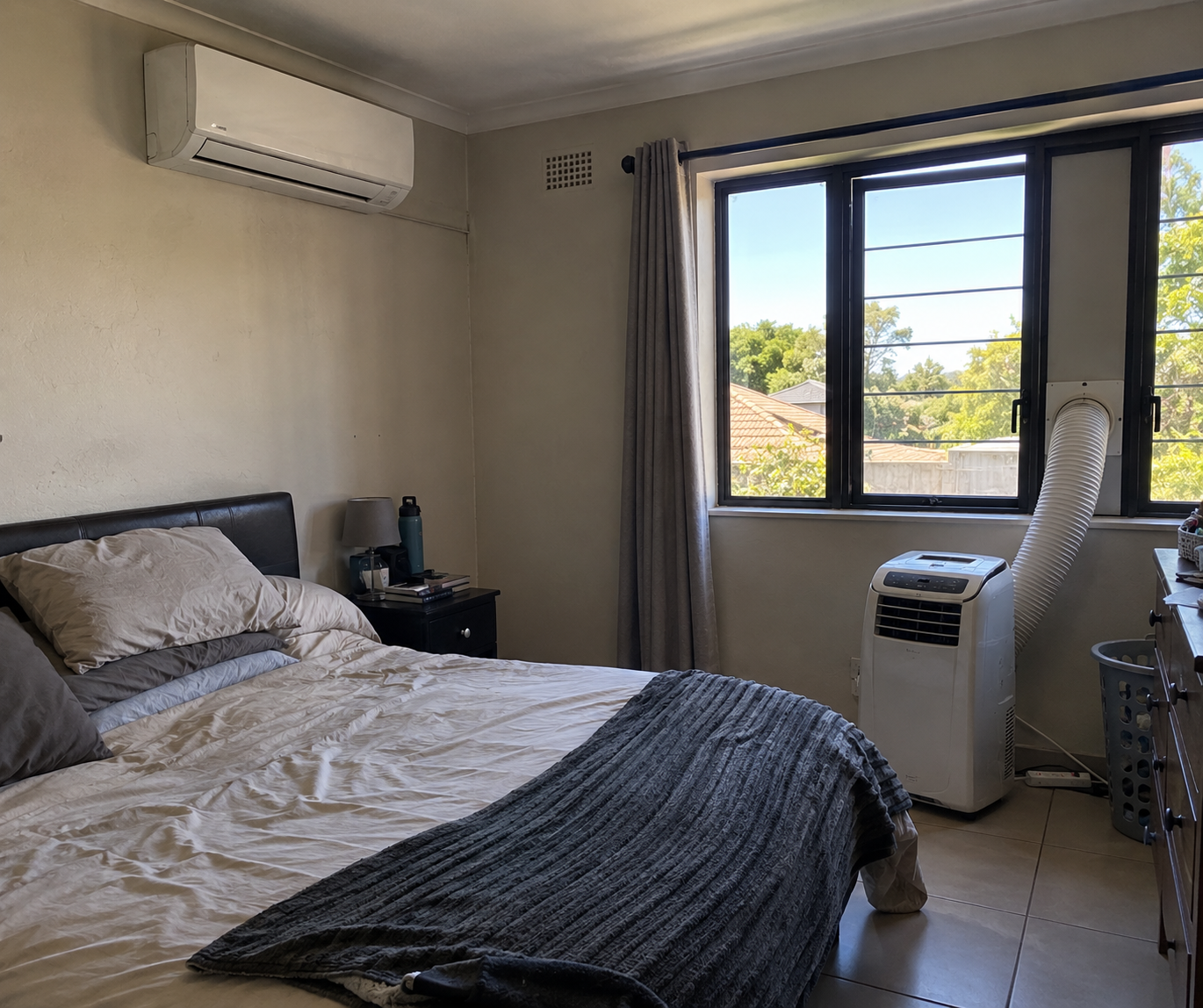
There is a big difference between moving an air conditioner into a room and installing one as part of the property.
A portable aircon can be unpacked, positioned near a window and moved when necessary. A split aircon becomes part of the building, with an indoor unit, outdoor condenser, refrigerant pipework, drainage and a fixed installation position.
That difference affects much more than appearance.
Portable units can be useful when flexibility matters, when permanent installation is not practical or when cooling is only needed occasionally. Split systems generally offer stronger, quieter and more consistent cooling for rooms that are used regularly, but they require proper installation and a suitable location for the outdoor unit.
The better option depends on the room, the property, how often the aircon will be used and whether you are looking for a temporary solution or something intended to serve the space for years.
Get Advice on the Right Aircon for Your Property
Tell King Handyman about the room you need to cool and get practical advice on whether a split or portable aircon is more suitable for the space.
What Is a Split Aircon?
A split air conditioner consists of two main units.
The indoor unit is installed inside the room and distributes conditioned air. The outdoor unit contains the compressor and other components and is positioned outside the building.
The two units are connected through the necessary refrigeration pipework, drainage and control connections.
Unlike a portable aircon, a split system is not designed to be moved from one room to another whenever you need it. The installation is planned around the property, including the position of the indoor unit, location of the outdoor condenser, pipework route, drainage and access for future maintenance.
This makes a split aircon a more permanent solution.
King Handyman installs split air-conditioning systems for homes, apartments, offices and suitable commercial properties in Cape Town. The installation requirements depend on the property, the room and the particular system being installed.
What Is a Portable Aircon?
A portable air conditioner is a self-contained unit that sits inside the room.
Instead of having a separate outdoor condenser mounted outside, the portable unit remains inside and uses an exhaust hose to discharge warm air, normally through a window or another suitable opening.
This makes the system considerably easier to move.
If you want to cool a bedroom tonight and move the unit to a home office tomorrow, you can generally do so without carrying out another permanent installation.
That flexibility is the biggest attraction of portable air conditioning.
It also comes with compromises.
The unit occupies floor space, the exhaust hose needs to reach a suitable outlet, and the room must still be arranged in a way that allows the warm air to be expelled effectively. Portable systems can also be noisier inside the room because the mechanical components are contained within the indoor unit.
Split Aircon vs Portable Aircon: The Main Differences
| Feature | Split aircon | Portable aircon |
|---|---|---|
| Installation | Requires permanent installation | Minimal installation required |
| Portability | Generally fixed in position | Can be moved between rooms |
| Indoor noise | Usually quieter | Can be more noticeable |
| Floor space | Does not occupy floor space | Takes up floor space |
| Cooling performance | Generally stronger for regular room cooling | Suitable for smaller or temporary applications |
| Appearance | Indoor wall unit with outdoor condenser | Freestanding indoor appliance |
| Outdoor unit | Required | Not required |
| Long-term use | Well suited to regular use | Better suited to flexible or occasional use |
| Property alterations | More involved | Much less permanent |
| Maintenance access | Requires access to indoor and outdoor components | Equipment remains indoors, with exhaust arrangement to consider |
These are broad differences rather than guarantees for every model. Individual air conditioners vary in capacity, efficiency, noise levels and features.
Which One Cools Better?
For a properly sized room, a split aircon will generally provide a more effective long-term cooling solution than a portable unit.
One reason is the location of the compressor and heat-rejection components.
With a split system, the outdoor unit is outside. The indoor unit is therefore responsible mainly for distributing conditioned air inside the room.
A portable aircon has to perform the cooling process within the room itself and then remove the unwanted heat through the exhaust arrangement.
That distinction matters.
The portable unit is physically sitting in the same space it is trying to cool, while the split system has separated the indoor and outdoor components.
This does not make portable air conditioning useless. A portable unit can be perfectly adequate for a small room or occasional cooling requirement.
But when the objective is reliable cooling for a bedroom, living room or office that is used regularly, a properly installed split system will generally be the more suitable arrangement.
Why the Exhaust Hose Matters With Portable Aircons
The exhaust hose is one of the most important parts of a portable aircon setup.
The air conditioner removes heat from the room, but that heat has to go somewhere.
If the exhaust hose is connected poorly, left with significant gaps around a window or routed in a way that allows warm air back into the room, the system has to work against conditions that make cooling less effective.
The hose itself can also become warm while the aircon is operating.
This is why simply placing a portable aircon in the middle of a room and switching it on does not guarantee good cooling.
The exhaust arrangement needs to make sense for the property.
A window that can accommodate the exhaust connection is often the most practical option, but the exact arrangement depends on the room and the equipment.
Does a Split Aircon Need More Work to Install?
Yes.
That is one of the main trade-offs.
A split system needs an appropriate location for the indoor unit and outdoor condenser. The two components must be connected, and the installation requires refrigeration pipework, drainage and appropriate electrical arrangements.
The wall construction and distance between the indoor and outdoor units can affect the installation.
The position of the outdoor unit matters too.
It needs adequate ventilation, stable support and reasonable access for future servicing.
The indoor unit should also be positioned so that air can circulate through the room rather than being blocked by curtains, furniture or structural features.
A good installation therefore begins before the drill comes out.
The proposed positions need to work together.
Is a Portable Aircon Better for a Rental Property?
It can be, particularly where permanent alterations are restricted.
A tenant may not have permission to mount an outdoor condenser, drill through exterior walls or install fixed refrigeration pipework.
A portable aircon avoids much of that work.
It can also be useful where the tenant expects to move to another property and wants to take the appliance with them.
However, the property still needs to accommodate the exhaust arrangement.
A portable aircon also occupies valuable floor space, which can become inconvenient in a small bedroom or home office.
If you rent a property and are considering a split system, permission from the landlord or property owner should be established before arranging installation. Apartments and sectional-title properties may also have additional requirements around exterior equipment and modifications. King Handyman’s installation guidance specifically highlights the need to consider landlord and body corporate requirements where applicable.
What About a Bedroom?
A bedroom is one of the situations where the difference between the two systems becomes noticeable.
A portable aircon can provide cooling without permanently changing the room. That may be useful in a rental property or a room that is only occasionally occupied.
The problem is noise.
Because the mechanical equipment is inside the room, the operating sound can be more noticeable while you are sleeping.
A split system places the compressor outside and can provide a quieter indoor environment, particularly once the room has reached the desired temperature.
The position of the indoor unit also matters.
Strong airflow directed directly at the bed can become uncomfortable, even if the room is otherwise cool.
For a bedroom that needs regular overnight cooling, a properly installed split system will often be the more comfortable long-term choice.
What About a Home Office?
A home office can go either way.
A portable aircon provides flexibility. If the room is used only occasionally, there may be little reason to install a permanent system.
But a home office that is occupied throughout the working day can benefit from a more permanent solution.
Computers, monitors and other equipment produce heat, while sunlight through windows can increase the temperature further.
Floor space can also be valuable in an office. A portable aircon can take up space that could otherwise be used for a desk, chair, storage or other equipment.
A wall-mounted split unit keeps the floor clear and provides a more permanent cooling arrangement.
Is a Split Aircon More Energy Efficient?
A direct comparison is not always as simple as saying that one type is automatically more efficient.
The particular model, cooling capacity, room conditions and operating pattern all matter.
A split aircon can be very efficient when it is correctly sized and installed because the system is designed around the property and the heat-producing components are located outside.
Portable aircons can also have their place, particularly when the cooling requirement is limited or temporary.
The biggest mistake is to compare two systems without considering how they will actually be used.
An aircon running for eight hours every day should be assessed differently from one switched on for an hour or two during occasional hot weather.
The size of the room matters too.
An aircon that is struggling to cool an oversized space may consume energy while still failing to provide the expected comfort.
Does the Size of the Room Matter?
Very much.
Neither split nor portable air conditioning should be selected without considering the area being cooled.
A small bedroom does not have the same requirements as a large open-plan living area.
Ceiling height, windows, insulation, direct sunlight, occupancy and heat-producing equipment also affect the cooling load.
A portable aircon that is adequate for a small enclosed bedroom may struggle in a large living area.
Similarly, installing an undersized split system will not solve the problem simply because it is a permanently installed unit.
Capacity needs to match the space.
This is particularly important when buying equipment before arranging installation.
If you already have a split aircon, providing the make, model and capacity along with photographs of the proposed installation area can help clarify whether the system is suitable for the room.
Which One Is Quieter?
A split aircon generally has the advantage here.
The loudest mechanical components are housed in the outdoor unit, away from the room.
Inside, you primarily hear the indoor fan and airflow.
Portable systems contain their mechanical components inside the room, so the operating noise is more noticeable.
For a living room during the day, this may not be a major concern.
For a bedroom at night, it can make a much bigger difference.
Noise is not determined solely by the type of aircon, however. Individual models vary, and installation quality can affect vibration and sound.
An improperly mounted split outdoor unit can transmit vibration through a wall, while a portable unit can also produce different levels of noise depending on its condition and operating mode.
Which One Takes Up Less Space?
A split aircon generally wins when floor space is limited.
The indoor unit is mounted high on the wall, leaving the floor available for furniture and everyday use.
The outdoor condenser does require its own space, but it is located outside the room.
A portable aircon needs a place on the floor.
That can be perfectly manageable in a spacious room, but it becomes more noticeable in a compact bedroom, office or apartment.
The exhaust hose also needs to reach an appropriate opening.
In a small room, these practical details can influence whether the portable system remains convenient after the novelty has worn off.
What About Installation Cost?
This is one area where portable aircons have an obvious advantage.
You generally do not need the same installation work involved with a split system.
There is no outdoor condenser to mount, no refrigeration pipework connecting two units and no permanent indoor unit installation.
A split aircon therefore involves a larger initial installation project.
The cost of that installation depends on the property and the work required.
Pipework length, mounting positions, brackets, drainage, access, wall construction and electrical requirements can all influence the scope.
An easy ground-floor installation can be very different from an upper-floor apartment where access is restricted and the outdoor unit has to be positioned carefully.
The cheapest option at the point of purchase is therefore not necessarily the cheapest option over the life of the system.
When Does a Portable Aircon Make More Sense?
A portable aircon can be a sensible choice when flexibility is more important than permanent installation.
It may suit a tenant who cannot make structural changes, a spare room that is only occasionally occupied or someone who needs temporary cooling without committing to a fixed system.
It can also be useful when moving the cooling equipment between rooms is important.
There are compromises, but those compromises may be acceptable when the system is not expected to provide permanent cooling every day.
The key is understanding what you are buying it for.
A portable aircon is not necessarily a cheaper version of a split system. It is a different type of solution.
When Does a Split Aircon Make More Sense?
A split system becomes more attractive when the room needs regular, dependable cooling.
It is particularly useful where the aircon will remain in one room and operate for several hours at a time.
Bedrooms, living rooms, home offices and commercial workspaces can all benefit from a permanent system when the property allows suitable installation.
The absence of an indoor compressor also makes a split system attractive where noise is important.
A fixed system can also look cleaner once installed, particularly when the pipework is routed and concealed appropriately.
King Handyman’s installation service covers new and replacement aircon installations for suitable homes, apartments, offices and commercial properties in Cape Town.
What About Apartments?
Apartments require a little more planning.
A portable aircon may appear attractive because there is no outdoor condenser to mount on the building.
A split system can still be an excellent solution, but permission and installation restrictions may apply.
The outdoor unit may need to be mounted on an exterior wall, balcony or another approved location. Body corporate rules can affect where equipment is allowed and how visible it can be.
Access can also influence the work involved.
An upper-floor apartment may require more careful planning than a ground-floor property.
The important point is to establish what the building permits before purchasing equipment or arranging permanent installation.
What About Offices and Commercial Properties?
A portable aircon can provide temporary relief in a small office, but it becomes less practical as the space and cooling requirement increase.
Commercial premises often have more people, computers, lighting, equipment and longer operating hours.
A portable unit occupying floor space and requiring an exhaust arrangement may also interfere with the way the workspace is used.
A properly selected split system can provide a more permanent arrangement, with the indoor unit positioned to distribute air without interfering with workstations or customer areas.
For larger or more demanding premises, the air-conditioning requirements should be assessed according to the property’s size, layout, occupancy and operating hours rather than choosing equipment based on a single room-size estimate.
King Handyman provides commercial air-conditioning installation, replacement, repairs, servicing and maintenance for suitable commercial properties across Cape Town.
Need Help Choosing Between Split and Portable?
If you’re unsure which system suits your room, property restrictions or expected usage, King Handyman can help you assess the practical installation and cooling requirements.
Maintenance Is Important With Both Systems
Neither type of aircon should be treated as maintenance-free.
Portable units need their filters and other accessible components kept clean, while the exhaust arrangement should remain unobstructed.
Split systems require attention to both the indoor and outdoor components.
Dust can accumulate around filters and coils. Drainage can become restricted. Outdoor units can collect dirt and debris around areas needed for airflow.
Cape Town’s conditions can also affect outdoor equipment. Wind, dust and coastal exposure can contribute to dirt accumulation and deterioration over time.
Regular servicing helps keep the system clean and provides an opportunity to identify developing problems before they turn into a breakdown.
King Handyman provides aircon servicing and maintenance for residential and commercial systems, with the work determined by the type, condition and use of the equipment.
What If the Existing Split Aircon Is Not Working Properly?
Poor cooling does not automatically mean that the entire system needs replacing.
An existing split aircon may have a blocked filter, restricted airflow, drainage problem, control fault, electrical issue or refrigerant leak.
The symptoms can overlap.
For example, an aircon that is not cooling properly could have a refrigerant problem, but it could also have restricted airflow or dirty components.
Refrigerant is not something an aircon normally “uses up” like fuel. If the system has lost refrigerant, the reason should be investigated rather than repeatedly topping it up without addressing the underlying problem.
King Handyman’s aircon repair service covers fixed systems experiencing problems such as reduced cooling, water leaks, unusual noises, unexpected shutdowns and failure to start.
Can a Portable Aircon Replace a Split Aircon?
Technically, both can provide cooling, but they are not interchangeable in every situation.
A portable unit can cool a room without the permanent installation associated with a split system.
The question is whether it can provide the level of cooling, noise control and convenience required by the property.
A portable system may be perfectly adequate for occasional use.
It becomes a less attractive solution when the room needs reliable cooling every day, floor space is limited, noise is a concern or the property would benefit from a permanent installation.
In that situation, a split aircon is usually worth considering.
Common Mistakes When Choosing Between the Two
One mistake is buying a portable aircon simply because it avoids installation without considering how much floor space the unit and exhaust arrangement will require.
Another is choosing a split system without checking whether the property allows an outdoor unit to be installed.
Buying an aircon based purely on price can also create problems. The cheapest equipment may not be the most appropriate for the room or the way it will be used.
Capacity is another important consideration.
A portable or split aircon that is too small for the room can struggle continuously, while choosing a much larger system simply because it appears more powerful does not automatically produce better results.
Finally, an existing aircon should not be replaced without considering whether the problem is actually a repair or servicing issue.
A faulty system and an unsuitable system are two different things.
Split or Portable: Which Should You Choose?
There is no single answer that applies to every property.
A portable aircon makes sense when you value flexibility, cannot carry out permanent alterations or only need cooling occasionally. It can be moved between rooms and does not require the same installation work as a split system.
A split aircon is generally the stronger choice when you want a permanent cooling solution for a bedroom, living room, home office or commercial space. It keeps the compressor outside, uses less indoor floor space and can provide quieter, more consistent cooling when correctly sized and installed.
The property itself should have the final say.
Consider how often the aircon will run, how much space is available, whether permanent installation is permitted, how important noise is and how much cooling the room actually needs.
For a rental property or temporary requirement, portability may outweigh everything else.
For a property where the same room needs reliable cooling year after year, investing in a properly installed split system can make considerably more sense.
Conclusion
Portable and split air conditioners solve the same basic problem, but they do it in very different ways.
A portable unit offers convenience and flexibility. It can be moved, requires relatively little permanent alteration and can be useful when a fixed installation is not practical.
A split system takes more planning and installation work, but it offers a more permanent solution. The compressor sits outside, the indoor unit does not occupy floor space and the system can provide comfortable cooling without the same indoor mechanical noise associated with many portable units.
Neither option should be selected simply because it is cheaper or easier to install.
Think about the room, the property, the amount of use and what you expect from the aircon over the next few years. If the requirement is temporary or flexible, a portable unit may do the job. If the room needs dependable cooling on a regular basis, a properly sized and installed split system is often the more practical investment.
Discuss Your Aircon Installation Options
If a permanent split system is the better fit for your property, King Handyman can assess the installation requirements and help you determine the most practical way to cool the space.