
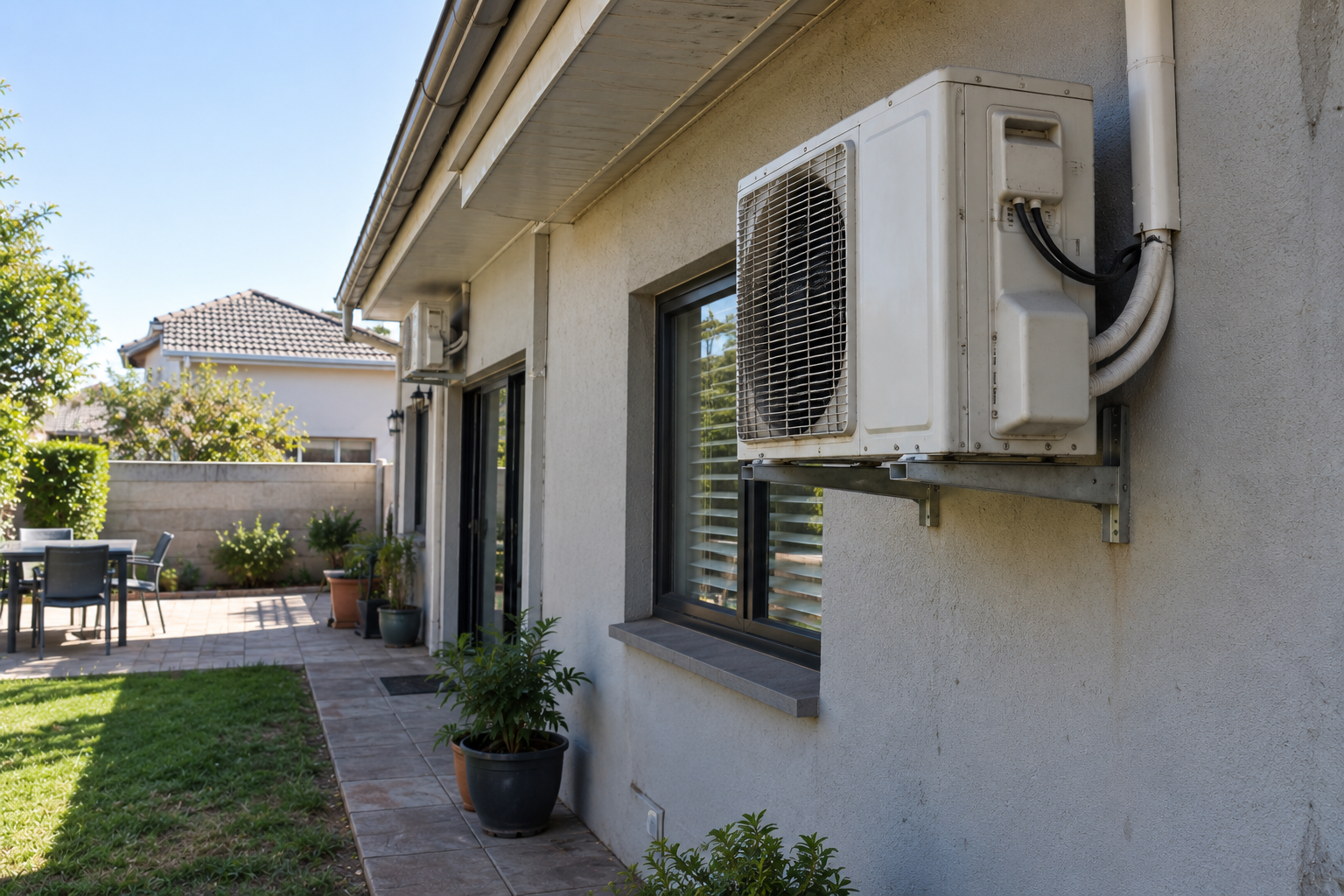
An air conditioner does not always need to run at full power.
Once a room reaches a comfortable temperature, there is usually no reason for the compressor to keep working at maximum output. This is where the difference between inverter and non-inverter air conditioning becomes important.
The two systems can both cool a room effectively, but they operate differently. An inverter aircon can adjust compressor speed according to the cooling demand, while a conventional non-inverter system generally operates by switching the compressor on and off to maintain the selected temperature.
That difference can affect energy consumption, temperature stability, noise and the way the system behaves during everyday use.
The better choice depends on the property and how the aircon will actually be used. A bedroom that runs for several hours every night has different requirements from a spare room used occasionally. An office operating throughout the working day has different considerations again.
For Cape Town properties, choosing between inverter and non-inverter technology is therefore less about deciding which one is universally “better” and more about finding the system that makes sense for the space.
Choose the Right Aircon for Your Property
Tell King Handyman about your home, office or commercial property and discuss whether inverter or non-inverter air conditioning makes the most practical sense for your needs.
What Is an Inverter Air Conditioner?
An inverter air conditioner uses variable-speed compressor technology.
Rather than operating at one fixed compressor speed and repeatedly switching the compressor off and on, an inverter system can adjust its output as the cooling requirement changes.
When a room is much warmer than the selected temperature, the system can work harder to bring the temperature down. Once the room approaches the desired temperature, the compressor can reduce its output rather than continuing to operate at maximum capacity.
This allows the system to respond to changing conditions inside the room.
For example, an aircon in a bedroom may initially need substantial cooling when it is switched on during a hot afternoon. Once the room has cooled, the heat entering through windows, walls and other sources may be relatively modest. The system can then operate at a lower output to maintain the temperature.
Modern inverter systems can also provide heating where the particular model has a heating function, which can make them useful beyond Cape Town’s warmer months.
How Does a Non-Inverter Aircon Work?
A conventional non-inverter air conditioner generally has a fixed-speed compressor.
When the room becomes warmer than the selected temperature, the compressor switches on and operates at its designed capacity. Once the desired temperature is reached, the compressor switches off.
As the room warms again, the compressor starts up once more.
This cycle continues while the aircon is operating.
It is a straightforward approach and does not mean that a non-inverter aircon cannot cool a room properly. A correctly sized and properly installed non-inverter system can still provide effective cooling.
The main difference is how the compressor responds to changing cooling demand.
An inverter system can vary its output. A conventional fixed-speed system generally relies on repeated starting and stopping.
Inverter vs Non-Inverter Aircon at a Glance
| Feature | Inverter aircon | Non-inverter aircon |
|---|---|---|
| Compressor operation | Variable speed | Fixed speed |
| Temperature control | More gradual adjustment | More noticeable cooling cycles |
| Energy use | Can be more efficient during longer operation | Can use more energy during repeated cycling |
| Upfront equipment cost | Generally higher | Generally lower |
| Noise | Often quieter once operating at lower output | Compressor starts and stops more noticeably |
| Best suited to | Frequent or longer periods of use | Occasional or shorter periods of use |
| Long-term considerations | Potential efficiency benefits depending on use | Lower initial equipment cost |
These are general differences. Actual performance depends on the particular air conditioner, its capacity, installation, room conditions and how it is operated.
Why Can Inverter Aircons Use Less Energy?
The main efficiency advantage comes from the ability to reduce compressor output once the room approaches the desired temperature.
Imagine an aircon installed in a home office.
When the office is hot at the beginning of the working day, the system may need to work relatively hard. Once the room reaches the selected temperature, however, the cooling requirement usually decreases.
An inverter system can reduce its compressor speed to match that lower demand.
A conventional system generally reaches the desired temperature and switches the compressor off. When the room warms again, the compressor starts at full capacity.
Repeated starting and stopping can consume more energy than maintaining a suitable temperature with a variable output system, particularly when the aircon is used for long periods.
That does not mean every inverter aircon will automatically produce a dramatically lower electricity bill.
Room size, insulation, sunlight, temperature settings, maintenance, operating hours and the efficiency of the specific model all matter.
An inverter system that is installed in an unsuitable space or operated with the doors and windows open will not magically overcome those problems.
Are Inverter Aircons More Comfortable?
They can provide more consistent temperature control because the compressor can adjust its output rather than repeatedly moving between full operation and off periods.
This can be noticeable in a bedroom or home office where maintaining a relatively stable indoor temperature matters.
With a fixed-speed system, you may experience more noticeable changes as the compressor cycles on and off.
An inverter system can instead continue operating at a lower output after the initial cooling demand has been met.
The result can be a more gradual and stable cooling pattern.
That does not mean the difference will be equally noticeable in every room. In a frequently opened room, a space with large amounts of heat entering through windows, or a property where the aircon is only used for short periods, the practical benefit may be less significant.
Which Aircon Is Quieter?
Inverter systems can have a noise advantage during normal operation because the compressor does not necessarily need to keep starting at full capacity.
Once the room has reached the desired temperature, the compressor can reduce its output.
This can make an inverter aircon particularly attractive in bedrooms, studies and home offices where noise is more noticeable.
However, the overall noise level is not determined by compressor technology alone.
The indoor fan, outdoor unit, mounting surface, vibration, installation quality and condition of the equipment can all influence how much noise you hear.
A poorly installed inverter system can still be noisy.
Likewise, a properly installed non-inverter system can operate quite comfortably.
If noise is a priority, the particular model and proposed installation location should be considered rather than choosing solely on the word “inverter.”
Is an Inverter Aircon More Expensive?
The initial purchase price of an inverter system can be higher than a comparable conventional system.
That is one of the main reasons some property owners still consider non-inverter air conditioning.
The purchase price, however, is only one part of the decision.
If an aircon is going to operate for several hours every day, the way it uses electricity becomes more important. In that situation, potential efficiency benefits may make the higher initial investment worth considering over the longer term.
On the other hand, if an aircon is installed in a room that is rarely used and only operates occasionally, paying more for inverter technology may not provide the same practical benefit.
The right decision should therefore consider both the upfront cost and the expected pattern of use.
When Does an Inverter Aircon Make More Sense?
Inverter technology can be particularly attractive where an air conditioner is used regularly for extended periods.
A bedroom that requires cooling throughout the night is one example.
A home office used every weekday is another.
The same applies to a living room where the aircon operates for several hours during warmer weather.
In these situations, the ability to adjust compressor output can be useful because the aircon is not simply being switched on for a few minutes and then turned off.
An inverter system can spend a substantial amount of time operating at reduced output once the room has reached a comfortable temperature.
This is where its operating characteristics become more relevant.
When Might a Non-Inverter Aircon Still Be Suitable?
A non-inverter system can make sense where the aircon is used occasionally or where the initial equipment cost is a major consideration.
For example, a spare bedroom that is rarely occupied may not justify paying significantly more for a system with features that will receive limited use.
The same could apply to a room that only requires cooling for short periods.
A non-inverter system can also be perfectly appropriate where the particular property and usage pattern do not justify the additional investment.
There is no rule that says an inverter aircon is always the correct choice.
The important thing is to avoid treating technology as a substitute for proper system selection.
A badly sized inverter aircon is still a badly sized aircon.
Does Property Size Affect the Decision?
Absolutely.
An air conditioner needs to have sufficient capacity for the space it is expected to cool.
A small bedroom, large open-plan living area and commercial office cannot be treated as identical simply because the same type of aircon is being installed.
Room dimensions are important, but other factors matter too.
Ceiling height, insulation, window size, direct sunlight, occupancy and heat-producing equipment can all influence the cooling requirement.
A home office containing several computers and monitors may require more cooling than an otherwise similar room used as a quiet bedroom.
Commercial spaces can be more demanding because of higher occupancy levels, longer operating hours, lighting, computers and other equipment.
King Handyman considers these practical factors when assisting with aircon installations rather than selecting a system purely according to floor area.
Get Advice Before Replacing Your Aircon
If you’re deciding between inverter and non-inverter technology, King Handyman can assess your property’s cooling requirements and help you choose a practical system for the space.
What About Cape Town’s Climate?
Cape Town properties experience a mixture of warm summer conditions and cooler winter weather.
That makes the way an aircon is used particularly important.
Some people may only need cooling during hot periods, while others may use a reverse-cycle system for both cooling and heating throughout the year.
A room with large windows and strong afternoon sunlight can experience significant heat gain during summer. A poorly insulated room may also require more cooling than a well-insulated one of the same size.
Coastal properties can introduce another consideration.
Outdoor air-conditioning units in coastal environments can be exposed to salt-laden air, wind and other conditions that make regular inspection and maintenance important.
The technology inside the aircon is only one part of how well the system performs.
The property itself plays a major role.
Inverter Aircons and Load Shedding
Electricity reliability is another consideration for South African properties.
However, an inverter air conditioner should not be confused with an inverter power system.
The word “inverter” in an aircon refers to the way the compressor’s electrical drive controls its speed. It does not mean that the air conditioner automatically provides backup power during an electricity outage.
If a property owner wants an aircon to continue operating during a power failure, a suitable backup power solution would need to be considered separately.
The compatibility between the aircon, electrical installation and backup system should be assessed properly rather than assuming that an inverter aircon can simply run from any existing inverter or battery system.
Where electrical work or new circuits are required, the appropriate qualified electrical professional should handle regulated electrical work.
Do Inverter Aircons Need Different Maintenance?
Both inverter and non-inverter air conditioners require appropriate maintenance.
Filters need attention. Coils and accessible components can accumulate dust and dirt. Drainage can become restricted, and outdoor units can become obstructed.
An inverter system has additional electronic components involved in controlling compressor operation, so fault finding can require a proper understanding of the particular system.
That does not mean inverter aircons are inherently difficult to maintain.
It means that a fault should be diagnosed rather than assuming that cleaning or adding refrigerant will solve every performance problem.
King Handyman provides aircon servicing and maintenance for suitable residential and commercial systems in Cape Town. The appropriate work depends on the type, condition and use of the equipment.
Does an Inverter Aircon Last Longer?
It would be misleading to say that every inverter aircon will automatically last longer than every non-inverter system.
The lifespan of an air conditioner depends on several factors.
Installation quality, operating hours, maintenance, environmental conditions, equipment quality and the severity of any faults that develop can all affect how long the system remains reliable.
An aircon that is correctly sized and maintained can be in a much better position than one that is constantly overloaded, regardless of whether it uses inverter technology.
Regular servicing also provides an opportunity to identify developing problems before they become more serious.
This matters particularly for commercial systems that operate for long hours.
What Happens If the Aircon Is Poorly Sized?
Choosing between inverter and non-inverter technology is important, but capacity comes first.
An aircon that is too small can struggle to cool the space effectively. It may run for long periods while failing to reach the desired temperature.
An unnecessarily large system can also be unsuitable because it may reach the selected temperature quickly and cycle differently from what is appropriate for the space.
The room’s size, ceiling height, insulation, windows, sunlight, occupancy and equipment should therefore be considered before deciding on the capacity.
Only after the cooling requirement has been established does it make sense to compare the advantages of inverter and non-inverter operation.
Is an Inverter Aircon Better for a Bedroom?
For a bedroom used every night, an inverter system can be an attractive option.
The system can reduce its output once the room reaches the desired temperature, which can support more consistent comfort and quieter operation.
This can be especially useful when the aircon remains on for several hours overnight.
However, the aircon should still be correctly sized.
A quiet inverter system that is too small for a sun-facing bedroom will not solve the underlying problem.
Positioning matters too. Airflow should be comfortable and should not unnecessarily blow directly towards the occupants.
Is an Inverter Aircon Better for a Home Office?
A home office can be a good environment for inverter technology because the aircon may operate continuously throughout the working day.
Computers, monitors, printers and other equipment generate heat, while the number of people in the room can also influence the cooling requirement.
An inverter system can adjust its output as the room’s cooling demand changes throughout the day.
For someone working in the room for several hours at a time, that can make more sense than selecting a system purely because it has the lowest initial purchase price.
Is an Inverter Aircon Better for an Office or Business?
Commercial properties require a slightly different approach.
An office may operate for eight or more hours a day, while a customer-facing business may have fluctuating occupancy throughout the day.
Computers, lighting, appliances and other equipment can add heat, while doors opening frequently can introduce warmer air into the conditioned space.
In these environments, operating efficiency and dependable temperature control can become more important than simply minimising the initial equipment cost.
The number of units also matters.
A larger property may require several air conditioners serving different areas rather than one oversized unit attempting to cool the entire premises.
King Handyman provides commercial air-conditioning installation, replacement, repairs, servicing and maintenance for suitable commercial properties in Cape Town.
What About an Existing Non-Inverter Aircon?
If an existing non-inverter aircon is still working properly, there may be no reason to replace it simply because newer inverter technology exists.
Replacement should make sense for the condition and use of the equipment.
If the unit is cooling adequately, the electricity consumption is acceptable and repairs or maintenance are straightforward, continuing to use it may be reasonable.
The situation changes when an older system develops repeated faults, becomes inefficient to operate, struggles to cool the room or reaches a point where replacement components become difficult to source.
At that stage, comparing the cost of continued repairs with the benefits of a newer system can be worthwhile.
King Handyman can assess an underperforming air conditioner to help determine whether the problem is repairable or whether replacement is the more practical option.
Should You Replace a Non-Inverter Aircon With an Inverter?
Not automatically.
The answer depends on why you are considering replacement.
If the existing aircon is old, inefficient, frequently requiring repairs or no longer suitable for the room, replacement may be worth considering.
If it is working well and is used only occasionally, replacing it solely to obtain inverter technology may not provide enough practical benefit to justify the cost.
The calculation becomes more interesting when an aircon is used frequently.
A system operating for many hours every day has more opportunity to benefit from efficient variable-speed operation than one switched on for short periods a few times a month.
The expected lifespan of the replacement system should also be considered.
Buying a new aircon is not simply about the technology inside it. Installation, capacity, location, maintenance and expected usage all form part of the decision.
What About Installation Cost?
The initial cost of an inverter system can be higher, but the final installation cost is not determined by inverter technology alone.
The capacity of the aircon, number of units, pipework length, drainage, mounting requirements and accessibility can all affect the installation.
An outdoor unit installed in an easily accessible position can present a different installation challenge from one requiring difficult access.
Apartments can also involve additional considerations around external walls, balconies, body corporate requirements and access.
For commercial properties, the number of units and size of the installation can significantly affect the scope of work.
This is why an aircon installation quotation should be based on the actual property rather than assuming that every installation costs the same.
Common Mistakes When Choosing Between Inverter and Non-Inverter
One mistake is choosing purely according to the purchase price.
The cheapest unit is not necessarily the cheapest system to own if it will be operating for many hours every day.
Another mistake is assuming that inverter automatically means lower electricity consumption in every situation. Usage patterns matter. An aircon that operates occasionally for short periods does not have the same opportunity to benefit from variable-speed operation as one running for long periods.
Choosing the wrong capacity is another problem.
Technology cannot compensate for an aircon that is too small for the room.
It is also easy to overlook installation quality. Correct pipework, drainage, mounting, positioning and airflow are all part of the system’s performance.
Finally, replacing a functioning aircon simply because inverter models are newer is not always financially sensible. The condition and use of the existing system should be considered first.
How Should You Choose?
Start with the property rather than the technology.
Consider how large the room is, how much sunlight it receives, how well insulated it is, how many people normally use it and whether computers, appliances or other equipment add heat.
Then consider how often the aircon will operate.
If it will run for long periods every day, inverter technology may offer advantages worth paying for.
If the room is rarely used and the aircon only operates occasionally, a non-inverter system may still be a perfectly reasonable choice.
The expected operating pattern should be part of the decision.
So should installation conditions, maintenance requirements and the likely future use of the property.
Inverter vs Non-Inverter: Which One Is Better?
There is no universal winner.
An inverter aircon is often the more attractive option for properties where the system will operate regularly for extended periods. Its variable-speed compressor can adjust output as the cooling requirement changes, which can support more stable temperatures and potentially lower energy consumption.
A non-inverter aircon can still make sense where the system is used occasionally, where the lower initial equipment cost is important or where the specific application does not justify the additional investment in inverter technology.
For many regularly occupied homes and offices, an inverter system can be a sensible long-term choice. For less frequently used rooms, the calculation can be different.
The important point is to choose the system according to the property rather than assuming one technology is automatically right for everyone.
Final Thoughts
Inverter and non-inverter air conditioners both have a place in residential and commercial properties.
The difference comes down largely to how the compressor operates and how that affects the way the system responds to changing cooling demand. Inverter systems can vary compressor speed, while conventional non-inverter systems generally switch the compressor on and off.
That difference can influence energy use, comfort and noise, particularly when an aircon operates for long periods.
But the technology is only one part of the decision.
The size of the room, insulation, windows, sunlight, ceiling height, occupancy, equipment and installation position all affect how an aircon performs. An appropriately selected and properly installed non-inverter system can be more suitable than an incorrectly selected inverter system.
For a property where the aircon will operate regularly, an inverter system is certainly worth considering. For occasional use, a non-inverter system may still provide a practical solution.
The best choice is ultimately the one that matches the property’s actual cooling requirements, expected usage and long-term priorities.
Choose the Right Aircon for Your Property
Tell King Handyman about your home, office or commercial property and discuss whether inverter or non-inverter air conditioning makes the most practical sense for your needs.